
The 52nd Bahrain Annual Fine Arts Exhibition: Eight Decades of Art, and Why the World Is Finally Paying Attention
- Feb 17
- 10 min read
Updated: Feb 18
The 52nd Bahrain Annual Fine Arts Exhibition opened on February 15, 2026, at the Bahrain National Museum in the presence of HH Sheikh Mohammed bin Salman bin Hamad Al Khalifa — a visual panorama celebrating the transformations of human experience and place.
This year's edition brought together a powerful cross-section of Bahraini artists working across painting, sculpture, installation, calligraphy, and mixed media. But to understand the significance of what was on display, you need to understand where it comes from — because Bahrain's art movement is not new. It is, in fact, the oldest grassroots art culture in the Gulf.

A Movement That Started Before Anyone Else
While cities like Dubai, Abu Dhabi, Doha, and Riyadh are now investing billions into museums, biennials, and art districts, Bahrain's modern art movement began quietly in the 1950s, decades before any of its neighbours had established a cultural infrastructure.
The first generation of Bahraini artists had no academic training or formal art education. Their initial attraction to drawing came from basic art classes in public schools and from spontaneous sketches driven by natural curiosity. These self-taught artists imbued their work with a passion for the landscapes of Muharraq and Manama, drawing from the rhythms of daily life, the architecture, the sea, and the palm groves.
Bahrain's visual culture cannot be understood without reference to its past. The roots reach back to the archaeological discoveries of the Dilmun civilization — engraved seals, domed tombs, and ancient city walls at Bahrain Fort dating to the Bronze Age — through the calligraphic, architectural, and decorative traditions of Islamic civilization. These layers are not abstract history. They are the living foundation on which Bahrain's modern artists built their visual language.
The pioneers — Nasser Al-Yousif, Abdulkarim Al-Orrayed, Ahmed Al-Sunni, Hussain Al-Sunni, Abdulatif Mufeez, Abdulkareem Al-Boosta, and others — turned Manama's sprawling markets into a free art school, drawing from the stories, customs, and traditions of Bahraini life. The recognition of art at that stage was akin to the discovery of hidden pearls. Al-Orrayed's shop on Sheikh Abdulla Street (1960), Al-Yousif's Al Talib Stationery Store, and Ahmed Baqer's studio near the old post office in Manama Souk (1967) became the incubators of a movement — part gallery, part gathering place, part cultural nerve centre.
Perhaps no story better illustrates the depth of this tradition than that of Nasser Al-Yousif (1940–2006). He pioneered printmaking in Bahrain after studying under the renowned Sudanese printmaker Mohamed Omar Khalil at Morocco's Asilah Arts Festival in 1980, returning to import four printing presses and create entirely new aesthetic possibilities on the island. When he lost his eyesight completely by 1992, his artistic willpower never waned — he continued creating linoleum prints by touch and scissors alone, exhibiting at Albareh Art Gallery as late as 2004. His hands replaced the role of the watchful eye.
The establishment of art associations from the 1950s onward — the Family of Art Amateurs, the Contemporary Art Association, and eventually the Bahrain Arts Society under Shaikh Rashid Al Khalifa since 1983 — created the institutional framework that sustained this grassroots energy. The Annual Fine Arts Exhibition, now in its 52nd edition, has been the backbone of this ecosystem since 1972, consistently nurturing new talent while honouring the legacy of those who came before.
What Was on Display: The 52nd Edition
This year's exhibition was a testament to that continuity. The works on show reflected the themes that have always animated Bahraini art — identity, memory, place, transformation — but expressed through contemporary vocabularies that speak to a global audience.

Jaffar Al-Oraibi presented "Salt Lake," a 56 × 76 cm work consisting of 14 paintings combining hand printing, photography, and salt on Arches paper — an exploration of humanity's relationship with its environment and the memory of place, inspired by salt extraction sites as repositories of historical experience. The work, he noted, is an extension of a three-year artistic journey.

The pioneer Ebrahim Busaad — who studied printmaking under Nasser Al-Yousif — contributed three oil paintings focused on the energy of colour, free compositional structure, and the visual relationship between mass and space.

Balqees Fakhro pushed beyond the purely visual and aesthetic, exploring pictorial structure and colour to generate emotional resonance, with a focus on the interplay between colour, void, and light. Haidar Al-Shaibani presented "Quran in Kufic Script," grounding contemporary treatment in the spiritual beauty of Arabic calligraphy. Sheikha Rasha Al Khalifa blended oil paint with cotton thread in "Morning Paper," adding a tactile dimension to a deeply personal domestic scene — her brother reading the newspaper, with a painting by the Egyptian artist and former Minister of Culture Farouk Hosni visible in the background, layering everyday intimacy with cultural memory.

Shaikh Rashid Al Khalifa showed two wall-mounted works — one in deep ultramarine blue, the other in white — each composed of a grid of small square openings cut into a curved surface. The pieces play with light, shadow, and depth in a way that shifts as you move around them, turning flat geometry into something almost architectural. His practice sits at the intersection of colour, form, and built space, and these works are a strong example of how abstraction can feel physical and immersive. There's a kinetic quality to them — they breathe with the room.

Saeed Radhi's "Monologues" series approached nature from a contemplative, emotional perspective — colour compositions reflecting the balance between calm and tension, mediating psychological and emotional states. Adnan Al-Ahmad's three works titled "Private Lesson" transformed the concept of education into an existential metaphor, with colours and symbols reflecting the inner anxiety and experiences that shape human identity.
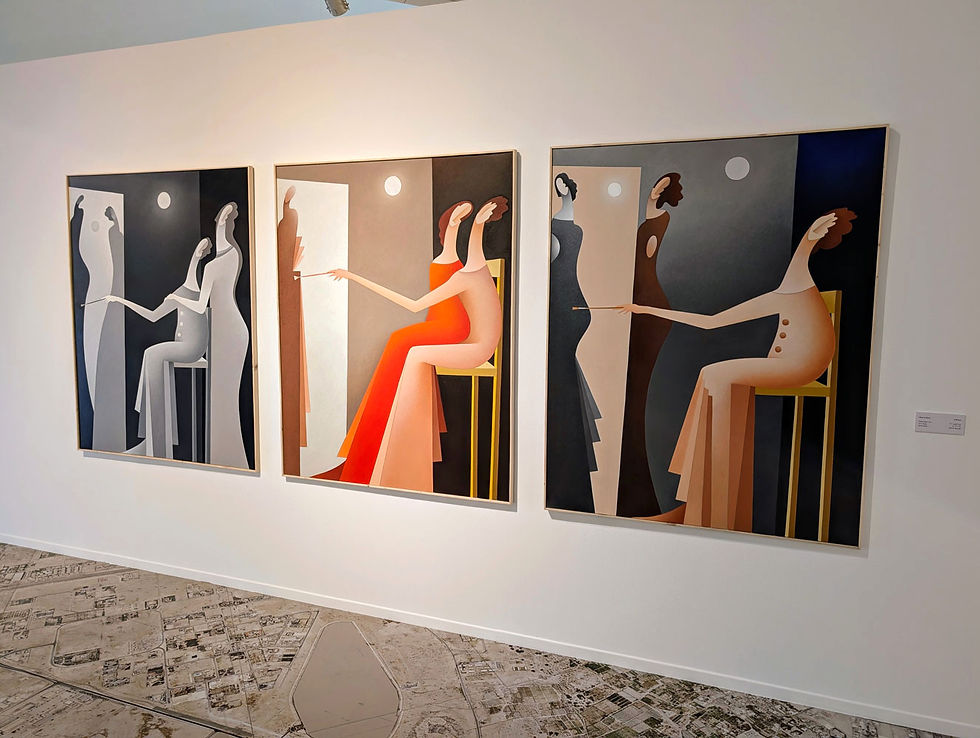

Mohammed Al-Mahdi presented "The Chaos That Inhabits Us," a series confronting the hidden fractures within modern civilisation — the moral hunger that lurks beneath the surface of progress. His work addresses societal chaos not as disorder of form but as disorder of the soul: the distortion of beauty, freedom, and meaning in an age where values shift at the speed of light, where wars are waged not only over land but over memory and consciousness, and where both hunger and excess reveal the same tragedy — the loss of meaning. Through contradictory colours, broken lines, and distorted forms, Al-Mahdi captures the human being at the moment of losing balance with self and world, each painting a cry, each deformed shape an attempt to restore the self before chaos consumes it. The chaos, he suggests, is not an enemy but a mirror — the space from which order is reborn.

Latifa Al-Sheikh's "Moving Narrative" merged acrylic, collage, and digital art to create a dynamic multi-media experience. Noor Al-Sairafi's "46 Echoes" series mapped the years of her life through the symbol of the butterfly — each painting a small story of personal transformation. Hadeer Al-Baqqali invoked the sea as a symbol of identity in "Sea of Bahrain."

Mariam Fakhro returned to her grandfather's house in Muharraq in "Islands of Memory."

Salman Al-Najm offered "Anthem of Joy" as a colour field for releasing memory and emotion.

Abbas Sarhan's paintings reflected the mangrove forests of Hamala — a landscape that holds deep ecological and cultural significance in Bahrain, and one that Sarhan renders with a quiet reverence for the natural environment.

The pioneer Abdullah Al-Muharraqi showed two large paintings dense with symbolism — tangled figures, masks, serpentine forms, and bold geometric backgrounds in deep reds, yellows, and greens. His work draws on Bahrain's maritime heritage and pearl diving history, but pushes far beyond illustration into something allegorical and almost surreal. There's a raw physical energy in his compositions — figures caught between struggle and transformation, layered with references to memory, labour, and identity. Decades into his practice, Al-Muharraqi's visual language remains one of the most distinctive in the Gulf, and these pieces reminded me why he's considered central to the development of contemporary art in Bahrain.

In sculpture, the pioneer Ali Al-Mahmeed presented two aluminium works, "Freedom 1" and "Freedom 2," inspired by birds as symbols of freedom and peace, incorporating calligraphic elements. The exhibition also paid tribute to the late artist Ali Ibrahim Mubarak through four works titled "Traces," honouring four decades of contribution to the local and international art scene.


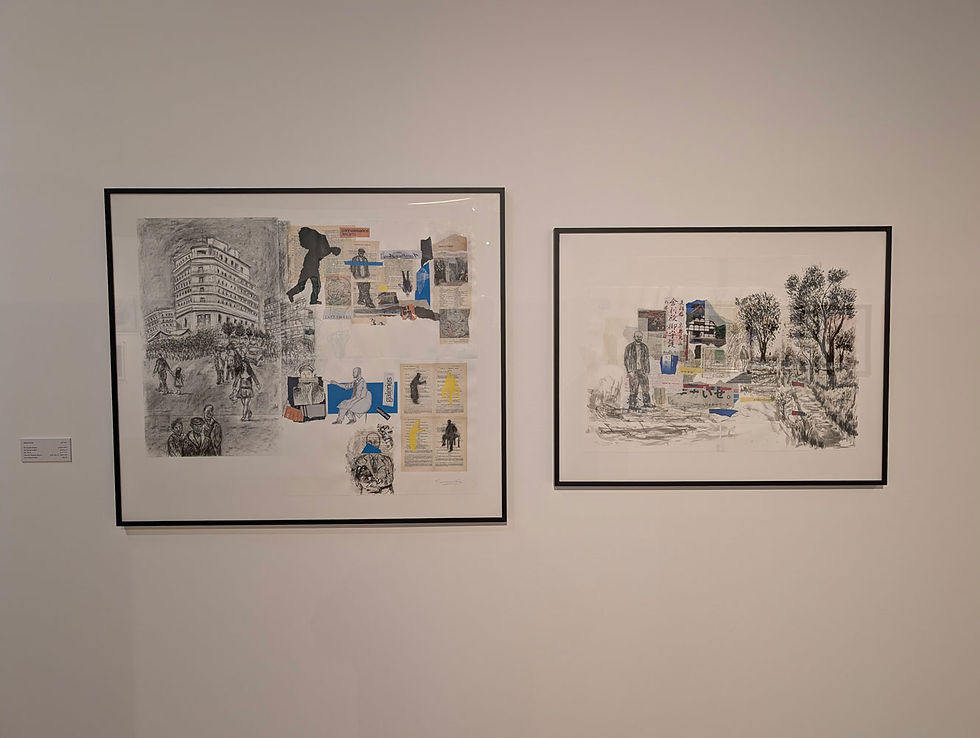
This year's Al Dana Award — the exhibition's highest honour — was awarded to Jabbar Al-Ghadban, a Bahraini graphic artist and printmaker who studied the craft under Nasser Al-Yousif. Al-Ghadban, who holds a degree in Fine Arts from the Faculty of Fine Arts in Damascus and whose work is held in collections including the Bahrain National Museum, the Arab Museum of Modern Art in Qatar, and Al Koufa Gallery in London, presented a series of four expressionist works connected to the suffering of the Palestinian people. Drawing from images observed on television screens, he merged acrylic with Chinese ink hatching and shading — a practice he situates at the intersection of drawing, graphic art, and printmaking. The works translate emotional impact into expressive visual language with intensity and sincerity.

Asghar Ismaeel — a pioneering figure who helped establish the Family of Art Amateurs, Bahrain's first artistic collective, in the 1970s — showed three oil paintings in his signature surrealist figurative style. In works like "Fisherman" and "Bint Al Nokhitha," faces dissolve into the world around them — fish, birds, cats, and fragments of memory nested within human features, as though an entire life's worth of sea-born mythology inhabits a single countenance. His distinctive approach embeds Bahrain's maritime folklore and intimate personal memories directly into the architecture of the human face.

Jamal Al-Yousif presented "Faces," a wall-mounted glass work consisting of six abstract faces formed through layering, sculpting, and full fusion. The work explores how human beauty lies in difference and individuality, with the kiln serving as a metaphor for life itself — reshaping features through time, experience, and pressure. The melted faces reflect the fluidity of identity and the honest presence of being human. They are not portraits of specific people, but echoes of humanity and uniqueness.

Sheikha Dwa Al Khalifa explored domestic space as a silent theatre for human relationships in her "Dinner Table" series — presence and absence rendered in vibrant oil pastels that balance movement and stillness. Hassan Al-Sari presented the marketplace as a collective memory — not merely commerce, but a living archive that passes across generations.


Aisha Hafez presented "Guardians of Silence" — three white sculptural cat forms arranged on stepped plinths, each composed of smooth, minimal features and repeated vertical ridges that give them a quiet architectural presence. The work draws on the ancient tradition of guardian figures placed at the thresholds of Assyrian cities — the lamassu and sacred sentinels — reimagined here as calm, watchful cats whose stillness is not emptiness but vigilance. Hafez works primarily in wood, stone, and composite materials, and has a strong track record of integrating sculpture within architectural spaces, including a five-by-five-meter public mural at The Suites Hotel inspired by Dilmun seals. These pieces carry that same spatial awareness — they feel like they belong in a building, not just a gallery.




Among the many other notable participants: Lama Al-Muayyad with "Between Shadows," Mohammed Bu Hassan with the installation "Chalk Trace," Mohammed Taqi with "The Humble Witness — Theatre of the Exiled," Shawq Al-Shawi with "Tulip Flowers," Dr. Zainab Al-Mohsen, Hussein Ali, Jihan Saleh, Ibrahim Al-Ghanim, Mariam Dashti, Abbas Al-Moussawi, and Adel Al-Abbasi with "Forbidden Apple."
Sheikha Marwa Al Khalifa, President of the Bahrain Arts Society, expressed pride in the exhibition's continuation, affirming that events like BAFEA reinforce Bahrain's position as an active cultural centre in the region and support artistic experiences that touch on human issues and national identity with an innovative, contemporary vision.
The range of work at this year's exhibition — across generations, mediums, and themes — raises a question that the international art market is only now beginning to ask seriously.
Why Collectors Should Pay Attention Now
The dynamics of global art acquisitions are shifting toward this region — and the shift is accelerating, backed by hard numbers.
Saudi Arabia's art market is booming. Sotheby's "Origins II" auction in Diriyah on January 31, 2026, generated $19.58 million with an 89% sell-through rate. Safeya Binzagr's 1968 painting "Coffee Shop in Madina Road" sold for $2.1 million — more than ten times its high estimate — shattering the record for a Saudi artist at auction and becoming the third highest price ever achieved by an Arab artist. This followed Sotheby's inaugural Saudi auction in 2025, which netted $17.3 million with bidders from 45 countries. In Abu Dhabi, Sotheby's Collectors' Week in December 2025 achieved $133.4 million in sales — described by the house as the largest debut for any new market in its history. Abu Dhabi's sovereign wealth fund ADQ invested $1 billion in Sotheby's, signalling long-term institutional commitment to the region's cultural economy.
The infrastructure is expanding just as fast. Abu Dhabi's Louvre and Guggenheim projects, the rebranding of Abu Dhabi Art as Frieze Abu Dhabi from its next edition, Qatar's thriving museum ecosystem, and the arrival of Art Basel in Doha and Dubai's gallery and fair infrastructure have all matured significantly over the past decade. New biennials, residencies, and institutional collections are emerging across the GCC at a pace that would have been unimaginable twenty years ago.
But here is what many international collectors and consultancies have yet to recognise fully: Bahrain was first. The grassroots art culture that took root in the 1950s — before any of its neighbours had begun to think about contemporary art infrastructure — produced generations of artists whose work carries an authenticity and depth that cannot be manufactured by institutional investment alone. This is art born from lived experience, from the archaeology of memory, from an intimate relationship with place that stretches back to the Dilmun civilization.
The 52nd BAFEA is evidence of a living, evolving tradition. The diversity of work on display — from salt-printed photography to ceramic sculpture, from layered glass to aluminium, from calligraphic abstraction to digital collage — reflects an art ecosystem that is confident in its roots and ambitious in its reach.
For collectors building GCC-focused collections, for art consultancies sourcing work for hospitality and architectural projects in the region, and for institutions looking to represent the full breadth of Gulf art history, Bahrain offers something no amount of capital can create overnight: depth. Eight decades of continuous artistic production, a community of artists working across generations, and a body of work that connects ancient heritage to contemporary practice.
The opportunity to acquire work from Bahrain's established and emerging artists — at this stage of regional and global recognition — is one that informed collectors will not want to miss.
Jamal Al-Yousif is a participating artist in the 52nd BAFEA. He creates site-specific glass and metal sculptures for architectural spaces, cultural institutions, and private collections. Based in Bahrain, working internationally. To discuss commissions or acquisitions, visit jamalalyousifstudio.com/commissions or get in touch directly.


Comments